Side by side
| Notes app | Dedicated tracker | |
|---|---|---|
| On hand when dosing | Yes | Yes |
| Speed of an entry | A few seconds of typing | A tap |
| Structure | Free text | Typed fields |
| Does the dose math | No | Yes, from the vial setup |
| Reminders | Separate, if at all | Built in |
| Remaining vial count | Manual | Derived |
| Searchable months later | Text search only | Filterable by field |
| Summarised for an appointment | Read the whole note | Export |
| Consistency of format | Whatever was typed that day | Enforced |
| Cost | Free | Varies; Peptmate is free |
The format drift problem
Free text has no schema, so the format is whatever seemed natural on the day. Over eight weeks a single note reliably accumulates entries like these:
- `Mon - 10u`
- `250mcg done`
- `0.1ml, new vial`
- `dose ✓`
- `skipped, travelling`
Every line was unambiguous when written. Together they are five different units of measurement, two implicit vials, and one entry that records only that something happened. Nothing here can be summed, filtered, or charted, and reading it back at a review means reconstructing intent line by line.
What notes cannot do
- Calculate. It cannot convert 250 mcg into a syringe mark, because it does not know the vial concentration, or that there is such a thing as a vial.
- Count down a vial. Remaining doses is arithmetic against a total; a note has neither number.
- Track an in-use window. The date of first entry is just more text.
- Remind. Notes are passive by design.
- Distinguish a missed dose from a missed entry. Both are an absence of text.
That last one is the quietly expensive one. A gap in a note is uninterpretable: neither you nor a healthcare professional can tell whether the dose or the logging was skipped, and the two mean entirely different things at a review.
When notes are enough
- A short protocol with a fixed dose and no vial changes, where there is little to calculate.
- A first fortnight, before it is clear whether tracking will continue at all.
- Alongside something structured, for the observations that do not fit a field.
If a notes app is the current approach, the improvement worth trying first is not switching tools. It is fixing the format. One line per dose, always the same fields, always the same units: date, compound, amount in the protocol unit, vial. That alone removes most of the drift.
What Peptmate does differently
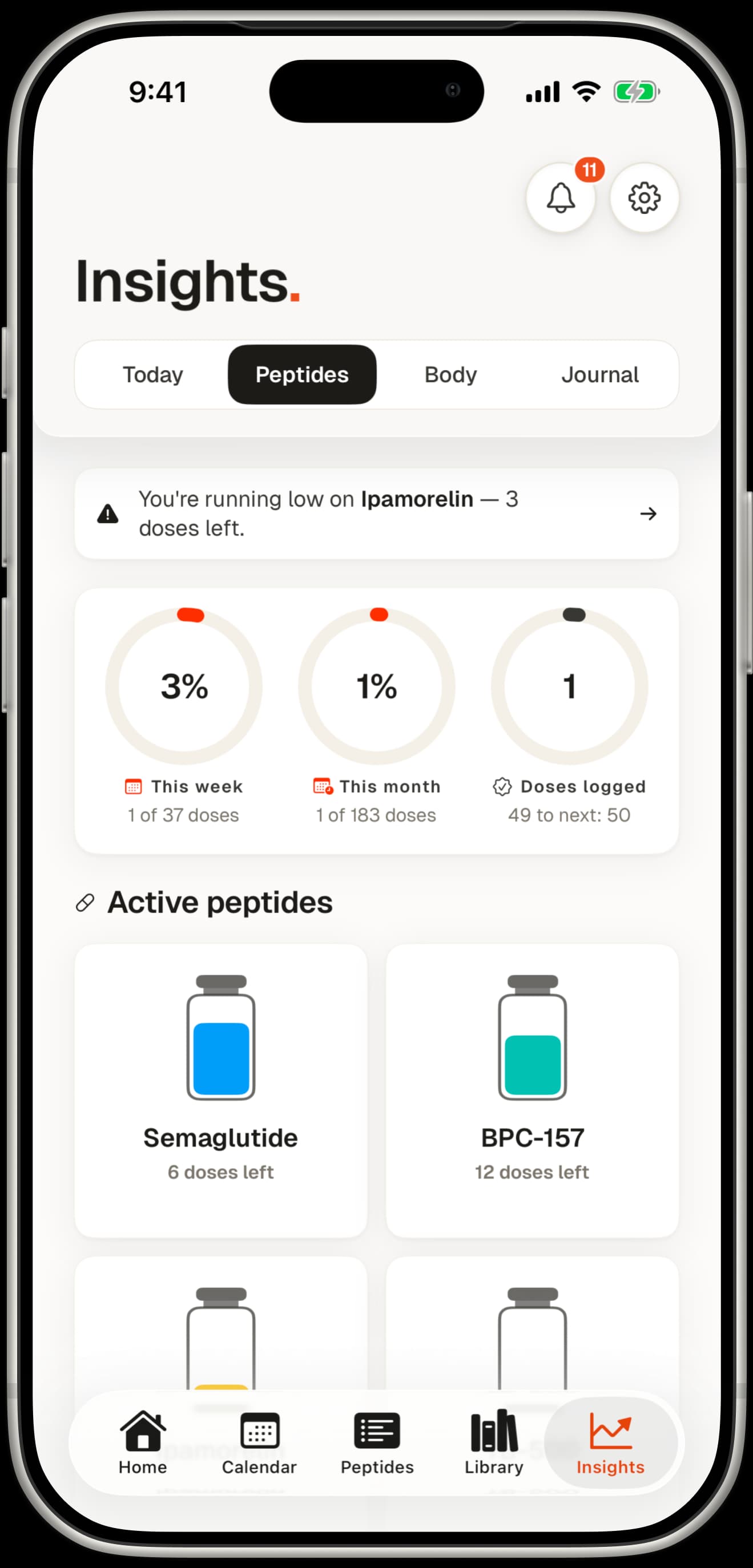
The fields are typed and the arithmetic is derived. Vial strength and diluent volume are entered once, so every logged dose carries its unit figure, remaining count is calculated rather than tracked, and the log exports as a record rather than as prose. It is iOS only, and the structure is fixed to what the app models. A notes app will always be more flexible than that.